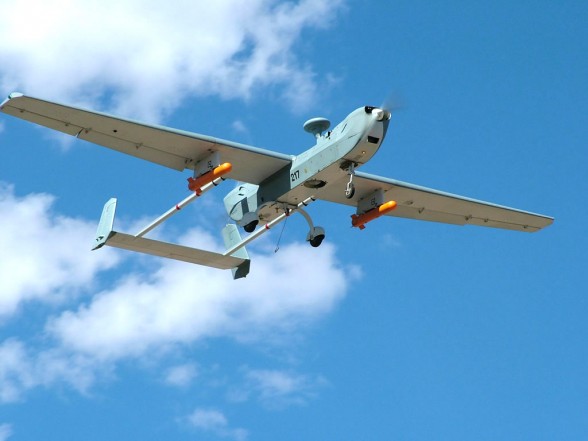
A view along the wingspan of Vietnam's new HS-6L HALE UAV


Vietnamese television and other media reports have revealed Vietnam's largest indigenous high-altitude long-endurance (HALE) unmanned aerial vehicle (UAV) to date, indicating that it will eventually perform civil and military missions over the South China Sea.

Reports from 10 and 11 December 2015 state that the new HS-6L HALE UAV is a product of Vietnam's Academy of Science and Industry and Ministry of Public Security. The twin-boom-configured HS-6L has a 22 m wingspan, a range of 4,000 km, an endurance of 35 hours, and is powered by a Rotax 914 engine.

The prototype was completed on 1 November 2015 and reports note that it will conduct flight testing over the South China Sea during the second quarter of 2016.

While its payload size has not been revealed, the HS-6L will reportedly carry optical and radar surveillance systems. In size, endurance and configuration, it is roughly in the same class as the Israeli Aerospace Industries Heron UAV.

However, it is likely that design assistance for the HS-6L came from Belarus. Vietnamese media reports noted the UAV unveiling coincided with a visit of the chairman of the Presidium of the Belarus Academy of Science: Professor Vladimir G Gusakov.

In November 2014 IHS Jane's reported that Vietnam was purchasing the 5.7-m wingspan Belarus 558 Aviation Repair Plant Grif-K UAV. This features a lightweight composite body and a twin-boom configuration similar to that of the larger HS-6L.
The Pentagon's Missile Defense System is working on plans to develop a high-altitude, long-endurance drone armed with a compact, electrically powered laser capable of shooting down ballistic missiles.

The original Airborne Laser Testbed (ALTB) was a Boeing 747 with a crew and tanks of toxic chemicals to generate power. That Pentagon mothballed the aircraft in 2012, after more than 15 years of development.

Now the Pentagon is taking the ALTB off the shelf with the plan of implementing the technology in an unmanned drone.

Despite the updated plans, the technical and tactical challenge remains the same: building a laser-armed aircraft that can shoot down ballistic missiles at their most vulnerable – boost phase, just after launch – without having to fly so close it would get shot down itself, Breaking Defense reported.

When the ALTB was first proposed, many unanswered questions existed. Regardless, the Missile Defense Agency went ahead with development, according to Frank Kendall, the Pentagon's procurement chief.

This time around, the Missile Defense Agency will take an "incremental, step-wise, knowledge-based," said MDA director, Vice Admiral James Syring.

"It is a very different approach than we did in the past of just leaping to something and investing everything we had," he said.

MDA will conduct experiments and review alternatives until 2018-2019, when Syring said it will pick "which technologies we think have the most promise." Then a "low-power laser demonstrator" will fly circa 2021, Breaking Defense reported.

"If it had been easy we would done it by now," Syring said. "But given the rapid progress in laser technology, it's not a huge reach."

"There's a lot of work that has go on," he continued. In the traditional "crawl, walk, run" scheme, "we're in crawl mode at this point, but that doesn't mean we should stop.

Mark Gunzinger, a laser expert and advocate at the Center for Strategic and Budgetary Assessments, said the technology for a laser-armed unmanned drone is within five years of being developed.

"I think the most important point may be that MDA's concept is not the 'return of the ABL,'" Gunzinger said in an interview with Breaking Defense.

"MDA's concept would take two maturing military technologies – unmanned systems and directed energy – and combine them to create a new weapon system that takes advantage of the attributes of both."

Read more: http://sputniknews.com/us/20150818/1025855855/pentagon-laser-drone-missile-defense.html#ixzz3jAREaXDn


A subsidiary of Russia's state technology corporation Rostec has unveiled the first photo of the Chirok, an amphibious reconnaissance and strike UAV outfitted with an air cushion, ahead of the MAKS-2015 international air show slated to be held near Moscow in late August.

The hardware could be operated in both manned and unpiloted modes. The multipurpose UAV is meant for conducting reconnaissance, monitoring and freight missions, including transporting people to remote areas. The military could fit it with missiles, rockets or bombs to use as a combat vehicle.

The Chirok (Teal), manufactured by the United Instrument Manufacturing Corporation (UIMC), has a maxim range of 1550 miles and could reach an altitude of nearly 20,000 feet. It has a maximum effective payload of 300 kilograms.

The drone is made out of composite materials which make it hard to detect the aircraft. "In addition, the UAV equipped with a reciprocating engine with controllable-pitch propellers is almost noiseless," the UIMC explained.

Developed by the Moscow Radio Engineering Research Institute, the air cushion design allows the Chirok to take off and land in virtually any conditions – from uneven surfaces, to sand or snow-covered and wetland territories, to water surfaces. The air cushion is retractable during flight.

The Chirok prototype was unveiled in mid-2014. In early 2015, the UIMC announced that two full-sized drones were ready for tests.

Russia's one of a kind drone is expected to enter production in 2006.
An Australian drone operator posted video of an eagle attacking his drone, the latest incident to suggest the need for greater caution when flying UAVs near animals.


TAIWAN unveiled the prototype of its largest ever military drone on Wednesday as it seeks to boost its defence forces in the face of a perceived threat from China.

The sleek, white unmanned aircraft is designed for intelligence gathering and surveillance missions, according to the National Chung Shan Institute of Science and Technology (CSIST), an arm of the Ministry of National Defence that is developing the drone.

It is more than twice the size of any of the existing fleet of 32 “Sharp Kite” drones used by Taiwanese forces.

“Our research and development capabilities are definitely not inferior (to China’s),” said Ma Wan-june, director of the aeronautical systems research division at CSIST.

Ma did not say when the prototype is to be put into use or give any further specifications.

“It’s equipped for automatic takeoff and landing, communications, optical detection, among others,” Ma said.

The drone was shown to reporters ahead of the biennial Taipei Aerospace and Defence Technology Exhibition which starts Thursday and is open to the public.

Taiwan in December launched its largest ever missile ship, the 500-ton corvette named “Tuo Chiang” -- the first of its kind to be produced locally.

The ship is armed with 16 missiles including eight supersonic Hsiung-feng III (Brave Wind) anti-ship missiles.

Self-governing Taiwan split from mainland China in 1949 after a civil war. But Beijiing still sees the island as part of its territory and does not rule out force to achieve reunification at some stage.

According to Taiwan’s defense ministry, China has more than 1,500 ballistic and cruise missiles trained on the island.


Russian unmanned air vehicle potentially capable of performing strike missions has been offical revealed, 1tv.ru of Russia's government having posted video of the first protocol UAV Altius following prime Minister visit.

Pictures showing the Altius UAV being produced a visit to Kazan by Russian prime minister Dmitry Medvedev on 25 March.

Images shows a high-winged aircraft apparently powered by two turboprop engines, with the design also featuring a slab-sided rear fuselage and a V-shaped tail. This could be a  first prototype UAV Altius (No. 001) for test.

Tatarstan-based Sokol and St Petersburg-based Tranzas won a 1 billion rouble ($33 million) contract in 2011 to develop a 5t-class medium-altitude, long-endurance UAV provisionally named Altius and a 1t-class system called Inokhodyets (Wanderer).

Speaking at the time of the award, Tranzas vice-president Viktor Godunov told ARMS-TASS that the new systems would be competitive with their foreign counterparts, have "colossal range and endurance" and be capable of "all missions, including strike".

Sokol is responsible for aircraft construction and the supply of ground systems, with Tranzas developing control systems and electronics for the Altius and Inokhodyets. Both should make their flight debuts during 2014, and enter detailed testing in 2015, according to Russian media reports.


Model UAV Altius

Lực lượng tác chiến điện tử của Quân đội Nga vừa đánh chặn thành công một máy bay trinh sát/tấn công không người lái MQ-5B của Không quân Mỹ trên bầu trời Crimea, báo cáo của Hiệp hội nhà nước Rostec cho biết hôm 14/3.
MQ-5B
Theo Rostec, chiếc UAV MQ-5B vừa bị đánh chặn thuộc lữ đoàn trinh sát số 66 của Quân đội Mỹ, đóng trên lãnh thổ Bavaria.

Báo cáo cũng cho biết rằng, đầu tháng 3 vừa qua, một phần của Lữ đoàn trinh sát 66 của Mỹ đã dịch chuyển tới khu vực Kirovahrad (Ukraina), và từ đây, họ đã triển khai các máy bay không người lái để thực hiện các nhiệm vụ trinh sát, giám sát vùng lãnh thổ Crimea và dọc theo biên giới Nga.

Trước đó, cũng đã có báo cáo cho rằng, các máy bay không người lái Mỹ đã xuất hiện ở khu vực Kherson, gần với danh giới Chongar giữa bán đảo Crimea và phần đất liền của Ukraina. Trong đó, Lữ đoàn trinh sát 66 của Mỹ được cho là đang triển khai tổng cộng 18 UAV MQ-5B.

"Đây là lần thứ hai UAV Mỹ bị đánh chặn ở Crimea", báo cáo của Rostec nói.

"UAV này đã bay ở độ cao khoảng 4.000m và mắt thường không thể nhìn thấy được. Nhưng đường truyền thông tin của UAV này đã bị phá vỡ nhờ sự trợ giúp của tổ hợp tác chiến điện tử 1L222 Avtobaza. Kết quả là UAV này đã phải hạ cánh khẩn cấp và được lực lượng phòng không thu giữ mà gần như không xảy ra hư hai nào", báo cáo nói.

Tổ hợp tác chiến điện tử 1L222 Avtobaza đã tham gia phục vụ trong Quân đội Nga một thời gian dài. Các thành phần của tổ hợp Avtobaza trước đây được sản xuất tại Nhà máy Bryansk, một phần của Tập đoàn Công nghệ Vô tuyến điện tử KRET. Sau này, việc sản xuất của các tổ hợp tác chiến điện tử (EW) ở Bryansk đã được chuyển giao cho doanh nghiệp khác của KRET là Kvant.
Trong năm 1964, chiến đấu cơ tuyệt đỉnh MiG-25 của Liên Xô lần đầu tiên thực hiện chuyến bay lên bầu trời. Nó được thiết kế đặc biệt cho nhiệm vụ đánh chặn các máy bay gián điệp của Không quân Mỹ, MiG-25 có thể dễ dàng đạt đến tốc độ bay Mach 2.8 (nhanh hơn gần 3 lần tốc độ âm thanh).

Theo đánh giá của các chuyên gia quân sự, ở thời kỳ MiG-25 xuất hiện, không gì có thể cản trở nó trở thành một biểu tượng khủng khiếp nhất, chỉ có loại máy bay gián điệp SR-71 Blackbird của Mỹ là nhanh hơn chút ít.

Trong gần 25 năm hoạt động kể từ cuối những năm 1960, Foxbats đã được triển khai tới hầu hết các căn cứ dọc biên giới để sẵn sàng phóng tên lửa nhắm vào những chiếc SR-71. Nhưng trong số đó, chỉ có một biến thể MiG-25R cho nhiệm vụ trinh sát/giám sát là có thời gian hoạt động lâu nhất.

Đạt tốc độ bay siêu nhanh và siêu cao, các máy bay MiG-25 của Liên Xô/Nga chính là câu trả lời cho SR-71 của Không quân Mỹ. Và khi những chiếc Blackbird cuối cùng phải ngừng hoạt động vào cuối những năm 1990, thì những chiếc MiG-25R được trang bị camera trinh sát vẫn còn hoạt động tới tháng 12/2013, bởi chúng đã quá già và quá tốn kém để bay lên bầu trời.

Không quân Mỹ, lực lượng hùng mạnh nhất thế giới đã thay thế SR-71 bằng các máy bay do thám không người lái tàng hình trước radar. Trong khi Nga vẫn cố gắng dựa vào những chiếc Foxbat già nua mà không có được sự thay thế trực tiếp nào, điều đó đã làm suy yếu đáng kể khả năng đánh chặn trên không của Moscow trước các đối thủ tiềm tàng của họ.

'Bất khả xâm phạm'

Có thể bay nhanh hơn để vượt qua một hệ thống phòng không bình thường là một nhiệm vụ nguy hiểm, nhưng MiG-25R cũng giống như SR-71, nó gần như không hề bị tổn thương trước đối phương.

Được chế tạo từ các tấm thép niken chịu nhiệt và một số hợp kim titan, cùng 2 động cơ phản lực Tumansky đạt lực đẩy "không tưởng", tới 45.000 pounds (khoảng 20.400kg), MiG-25 đại diện cho một sự tiến bộ khủng khiếp về công nghệ quân sự quân đội Sô Viết thời Chiến Tranh Lạnh.

MiG-25 được trang bị một radar Smerch-A có thể dẫn đường cho tên lửa đánh chặn R-40 tấn công mục tiêu ở cự li xa tới 65km. Khi còn phục vụ trong Không quân Liên Xô, MiG-25 đã chứng minh được sự nguy hiểm của nó với các kế hoạch chiến tranh của Mỹ và NATO. Trong cuộc chiến vùng Vịnh năm 1991, một chiếc MiG-25 của Iraq đã bắn rơi một chiếc máy bay F/A-18 và năm 2002 bắn rơi một máy bay không người lái Predator của Không quân Mỹ.

Tuy nhiên, biến thể trinh sát của MiG-25 mới được các chuyên gia phương Tây đánh giá cao nhất. Hầu hết các nước sử dụng Foxbat đã bắt đầu cho chúng nghỉ hưu từ những năm 1990 do chi phí vận hành tốn kém, sử dụng phức tạp và tuổi thọ của khung thân và động cơ ngắn. Tuy nhiên, Nga và một số nước còn lại vẫn tiếp tục giữ lại các máy bay MiG-25R cho nhiệm vụ trinh sát. Theo các số liệu cho thấy, tới tháng 1/2013 Không quân nga vẫn triển khai hơn 20 chiếc Foxbat ở hai căn cứ.

MiG-25RBT là một biến thể trinh sát ảnh với một cameras gắn ở trên mũi. MiG-25RBF có thể nhận được các tín hiệu điện từ phát ra từ các radar của đối phương, còn MiG-25R từng tham gia bay gián điệp ở Chechnya và Ingushetia trong những năm 1990.

SR-71 đã được Mỹ thay thế bằng các máy bay trinh sát không người lái (UAV) RQ-170, RQ-4, và chẳng bao lâu nữa là cả RQ-180, nhưng công nghiệp không gian của Nga vẫn không dựa vào các máy bay robot. Và khi các vệ tinh chỉ soi được những vị trí cố định từ không gian thì MiG-25R vẫn là giải pháp tốt nhất để Moscow có thể tìm kiếm mục tiêu của đối phương mà không cần báo trước. Các máy bay ném bom Su-24 và Tu-22 cũng có thể mang theo cameras, nhưng có tốc độ bay chậm hơn MiG-25 và dễ bị tổn thương trước hệ thống phòng không của đối phương.

Các phi đội MiG-25R của Không quân Nga dần dần được thu nhỏ lại và chỉ còn một số chiếc còn được triển khai ở căn cứ không quân Monchegorsk ở vùng Tây Bắc đất nước. Điện Kremlin đã bắt đầu sửa chữa lại đường băng ở Monchegorsk vào cuối năm 2013 và chính thức đưa những chiếc MiG-25R cuối cùng ra khỏi phục vụ trong tháng 12/2013.

Một số lượng nhỏ MiG-25 được báo cáo là vẫn đang được bảo trì hoạt động ở Algeria, Armenia, Azerbaijan và Syria.

Theo nhận định của các chuyên gia quân sự phương Tây, việc Nga chính thức loại bỏ toàn bộ các máy bay MiG-25 ra khỏi phục vụ sẽ tạo ra một khoảng trống về khả năng trinh sát của quân đội nước này. Tuy nhiên, cũng có thể Moscow đã chuẩn bị sẵn sàng cho sự vắng mặt MiG-25 trong không quân của họ, có thể là một vài máy bay có người lái mới, hoặc cũng có thể là những dự án UAV trinh sát bí mật hơn đã hoàn thành.

Theo Combataircraft
| Copyright © 2013 Vietnam Defence